Section 03
A geography of surfaces: why the same team travels badly
Cricket is played on a prepared strip of soil in the middle of a grass field, and neither the soil nor the grass is standardised. Add three commonly used match balls, wide differences in humidity and altitude, and the fact that the surface changes over the course of a multi-day match, and you have most of the explanation for results that otherwise look inexplicable.
The four variables worth separating
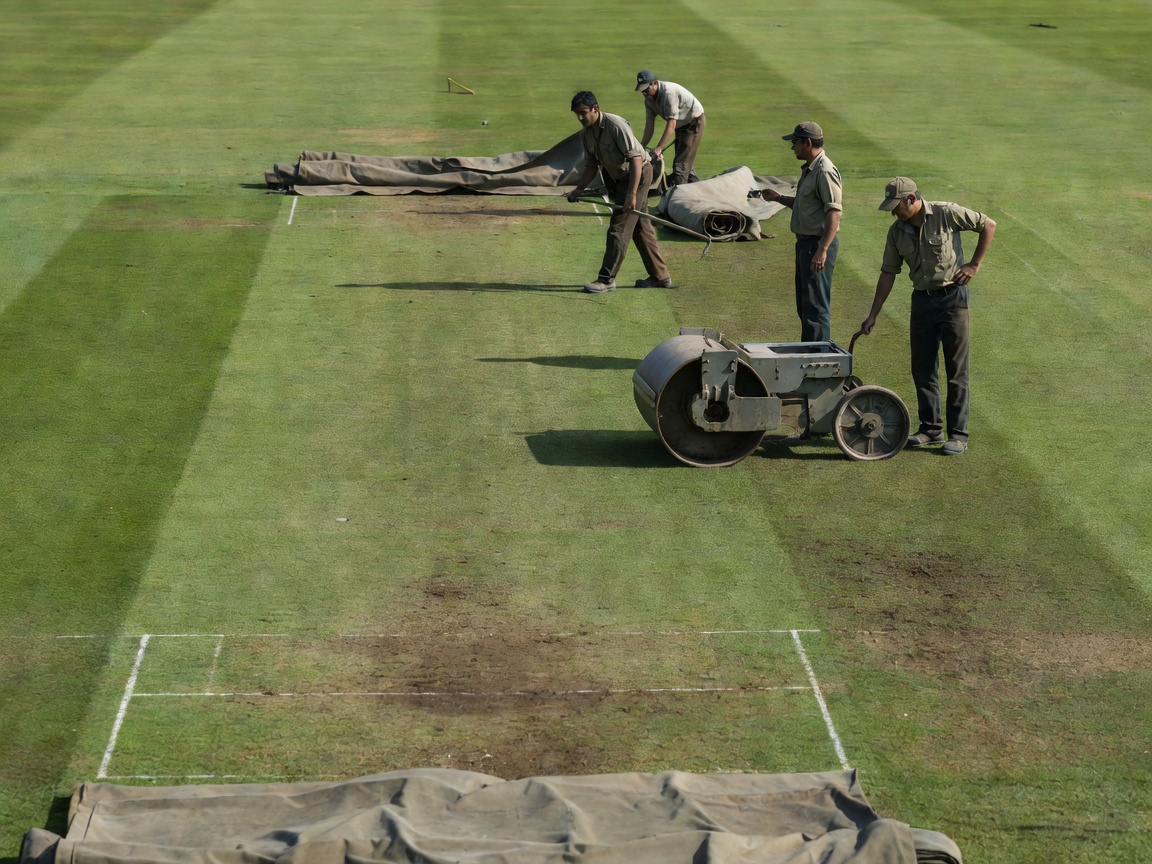
It helps to treat conditions as four things rather than one atmosphere. The pitch — the prepared strip — governs bounce, pace and how much the ball deviates off the seam or with spin. The ball governs how long the seam stays proud and how readily the surface of the ball scuffs. The air — humidity, cloud, wind, altitude — governs swing and carry. The outfield governs whether a well-timed shot reaches the boundary or is stopped short. Commentary tends to collapse all four into "the conditions", which loses most of the useful information.
Soil, grass and the life of a pitch
A pitch is prepared by rolling and drying soil to a chosen hardness with a chosen amount of grass left on top. Clay content is the dominant factor: soils high in clay bind hard and tend to produce even bounce, while looser soils break up sooner and produce turn later in a match. Grass cover holds the surface together and gives the seam something to grip, which is why a green-looking pitch is usually a hint about seam movement rather than about speed.
Over a five-day match the same strip passes through several personalities. Early on it may be firm and slightly damp, favouring seam. As it dries it usually becomes truer, which is why the second day is often the best time to bat. Later, footmarks accumulate outside the line of the stumps and cracks open, both of which give spin bowlers purchase and make the bounce less predictable. That progression is why the toss carries more weight in Test cricket than anywhere else, and why the fourth-innings run chase is the format's most demanding assignment.
Regional character, held loosely
Generalisations about countries are useful starting points and unreliable rules — venues within a country differ as much as countries do, and preparation practices change. Read the following as tendencies rather than laws.
- England and Ireland. Cooler air, frequent cloud and soils that hold moisture make lateral movement through the air and off the seam the defining threat. Sessions can change character with the weather rather than with the surface.
- Australia. Harder, drier surfaces with more pace and bounce, and generally larger playing areas, which alters both shot selection and field settings. Conditions vary widely between coasts and climates within the country.
- India, Sri Lanka and Bangladesh. Warmer and often more humid, with surfaces that tend to be slower and to assist spin, either from the first day or as the match wears on. Reverse swing — movement generated by an older, scuffed ball — has historically been more prominent where outfields are abrasive.
- Pakistan and Afghanistan's home arrangements. Dry heat and low-moisture soils, with the added complication that some home fixtures have been staged at neutral venues, so "home conditions" is not always a straightforward description.
- South Africa and Zimbabwe. Firm surfaces with genuine carry, and in the higher-altitude interior a thinner atmosphere that lets the ball travel further and can reduce conventional swing.
- West Indies. A group of islands rather than a single condition. Sea breezes, varied soils and grounds of different sizes mean a tour can present several distinct problems in succession.
- New Zealand. Wind is often the most underrated variable in world cricket; a strong crosswind changes which end a captain wants to attack from as much as any pitch report.
The ball is part of the conditions
Three balls are in common use in Test cricket and they are not interchangeable. Dukes balls, associated with English conditions, are known for a pronounced hand-stitched seam that tends to stay upright longer. Kookaburra balls, used across much of the rest of the world, have a machine-assisted seam that tends to flatten sooner, shifting the advantage towards spin and towards the first few overs of each new ball. SG balls are used in India. The practical consequence for a viewer is that the same bowler's plan may be viable for a long stretch in one country and for a short window in another, which is a fairer explanation of a poor away record than any judgement about temperament.
In limited-overs internationals a white ball is used, and it discolours faster than a red one, which is why playing conditions govern ball changes and why a floodlit innings may behave differently from the daylight innings that preceded it. Where a Test is played into the evening, a pink ball is used because it remains visible under lights.
What a touring side can actually do about it
Preparation options are real but limited. Warm-up matches allow acclimatisation, though modern schedules leave fewer weeks for them, and the trade-off between playing a preparatory fixture and resting a squad is a live one. Selection is the other lever: an attack chosen for seam-friendly conditions looks very different from one chosen for a dry surface, and a batting line-up built around spin will be picked differently again. The uncomfortable conclusion is that away records tend to compress toward the middle for everyone — sides win less often abroad, and the sides that travel best are usually the ones willing to change their method rather than repeat it more loudly.
How conditions and the rulebook meet is the subject of the next section: Laws & Officiating. Or read Following the Game for how all of this shows up in the numbers.